US market entry from zero: 3,617 validated contacts across 4 verticals
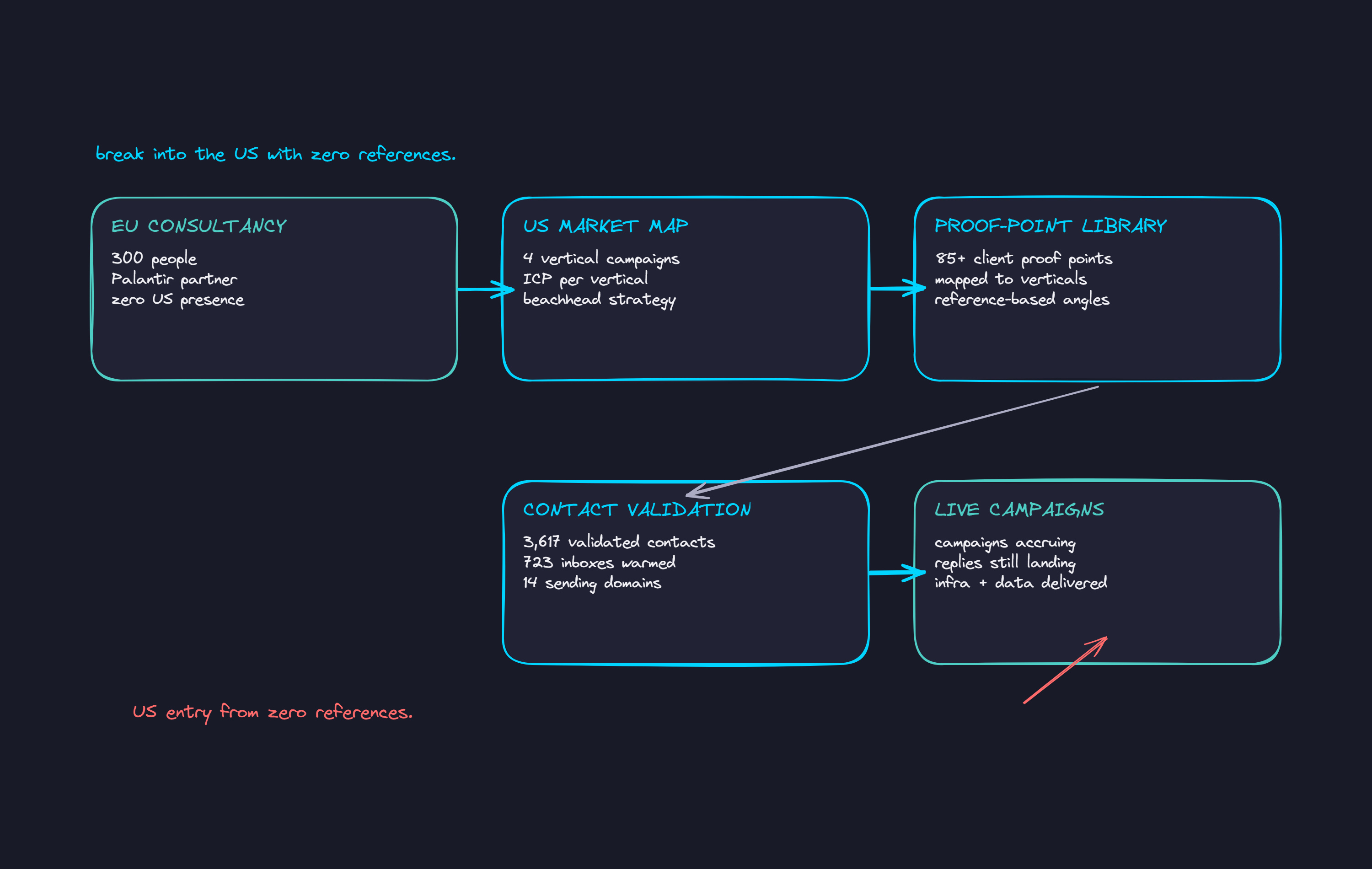
A 300-person European data and AI consultancy (Palantir partner) needed a US beachhead. This is the sourcing, proof-point, and infrastructure build that took them from no US presence to live campaigns.
The Client
300-person European data & AI consultancy, Palantir partner.
The Problem
Zero US presence, zero US references, crowded market.
The Build
Vertical-split sourcing, 85+ client proof points mapped to campaigns, full sending infrastructure.
The Outcome
Campaigns live and accruing replies; infrastructure and data layer delivered.
Context
The client
A 300-person European data and AI consultancy with deep enterprise credentials. Reference clients include global reinsurers, pharmaceutical companies, automakers, and private equity firms. Their strongest differentiator is a certified Palantir Foundry partnership spanning 6+ years and 150+ projects, helping large enterprises onboard, scale, and maximize ROI on the platform.
Their European pipeline was healthy, built through founder-led sales, conference presence, and inbound. But they had a mandate to expand into the US, and the gap between "we should be selling in the US" and "we have a pipeline in the US" was total. No SDR function. No outbound infrastructure. No brand recognition in North America. One US-based team member, with everyone else on a 5 to 7 hour timezone delay from Europe.
Constraints
Why this was hard
- Zero outbound infrastructure. No SDR team, no sending domains, no inbox warm-up, no sequences, no enrichment pipelines. Everything had to be built from scratch.
- The US market was completely new. European brand equity, reference clients, and the conference circuit carry no weight with a VP of Data at a US insurer who has never heard of them. Every email has to earn credibility from the first sentence.
- The most valuable contacts were also the most fragile. The client identified roughly 150 to 170 confirmed Palantir Foundry users across their verticals, the highest-probability pipeline. Burning them with unproven messaging would waste the single best asset the campaign had.
- Four distinct verticals, each needing different positioning. Insurance and Reinsurance, Banking and Wealth Management, Life Sciences, and Medical Devices. Generic "we do data and AI" messaging would be invisible.
- Timezone operations gap. With one US-based team member and the rest in Europe, warm replies hitting at 2pm Eastern would sit unanswered until the next morning CET. The campaign had to be designed around this.
- HubSpot data skewed entirely European. The CRM was rich with European contacts but nearly empty for the US. No existing list to warm-start from, no historical US engagement to inform targeting.
Architecture
The system
One engine, several layers. A phased campaign structure protects the highest-value contacts, Palantir signal detection decides who gets which message, a proof-point library grounds every email in a real outcome, and unified compliance plus sending infrastructure sit under everything before a single email leaves.
Phased campaign architecture
The decision that mattered most was send order, not send copy. Phase 1 runs four parallel vertical campaigns against high-ICP, non-Palantir companies to validate messaging and reply patterns. Phase 2 then targets 409 Palantir-focused contacts, roughly 150 to 170 confirmed Foundry users, only after Phase 1 has proven positioning.
Palantir Foundry signal detection
No database has a "Foundry user: yes or no" field, so I built a multi-source detection system across 4 channels: job postings, LinkedIn activity, press releases, and technical content. Each company got a signal strength score (strong, medium, weak) that directly set how confident the email reference could be.
Proof-point personalization
I extracted 85+ quantified proof points from the client's case studies (29 insurance, 28 banking, 28 pharma), each tagged by industry, service line, pain point, outcome, and persona. The copy system matched proof points to recipients by vertical, company size, and detected pain signals.
Company-size diagnosis language
Five company-size tiers per vertical, each with calibrated diagnosis language, case-study selection, and CTA framing. Not five campaigns: one campaign with five lenses applied automatically from Clay enrichment data.
Unified DNC compliance
A single 382-entry DNC list built from 8 blacklisted domains, 325 HubSpot unsubscribes, 44 competitors, and 5 internal domains. It caught 30 companies that appeared in both Phase 1 and Phase 2 pools before they could receive overlapping sequences.
Infrastructure at scale
723 inboxes across 14 domains, wide rotation to protect deliverability, warm-up started April 1 2026, no links in any email, one contact per company, and all warm replies routed to the US-based team member for same-timezone follow-up.
Results
What is live today
The campaigns are live and accruing replies. The figures below are what has been delivered and is running: the reply and meeting numbers are not reported here because they are still accumulating.
| Metric | Result |
|---|---|
| Companies sourced | 552 |
| Companies after ICP filter | 427 |
| Total validated contacts | 3,617 |
| Campaign tracks | 6 (4 vertical + 2 Palantir) |
| Phase 2 Palantir contacts | 409 (~150-170 confirmed) |
| Inboxes provisioned | 723 |
| Sending domains | 14 |
| Case study proof points | 85+ |
| DNC list entries | 382 |
| Cross-phase overlaps caught | 30 companies |
| Warmup start date | April 1, 2026 |
| Phase 1 reply rate | Campaign Active |
| Phase 2 reply rate | Campaign Active |
| Total meetings booked | Campaign Active |
The 85+ extracted proof points with quantified outcomes represent the kind of preparation most outbound campaigns skip. The infrastructure (723 inboxes, 14 domains, a 382-entry DNC, and 3,617 validated contacts across 6 tracks) is what it actually takes to launch a US market entry for an enterprise consultancy. This is not a 200-lead test. It is a full outbound engine built from nothing.
Want an engine like this for your market entry?
Book a 15-min callFit
Who this is for
- Enterprise services firms entering a new market with zero outbound infrastructure. If your pipeline has been founder-led, conference-driven, or inbound, this is the architecture that gets you from zero to pipeline without the 18-month SDR hiring cycle.
- Companies with a small pool of high-value targets they cannot afford to burn. If 100 to 200 contacts represent your best opportunity, the phased approach validates on lower-stakes contacts first, then applies the learnings to the high-value pool.
- B2B firms with deep case study portfolios they are not leveraging. If you have dozens of quantified outcomes sitting in slide decks but your cold emails still say "we help companies like yours," extracting and matching proof points by vertical and size turns past delivery into present pipeline.
Stack
Tools used








Ready to enter a new market with zero outbound infrastructure?
See how I can build the outbound engine that takes you from no pipeline to qualified conversations.
Book Your Free Strategy Call