An 8.95% reply rate in Swiss healthcare, 3x the industry benchmark
A Swiss software company selling an AI chatbot into healthcare needed conversations with clinics. Compliance-safe cold email with tight segmentation got nearly 1 in 11 prospects to reply.
The Client
Swiss software company with an AI chatbot for healthcare providers.
The Problem
Regulated market, cautious buyers, no outbound pipeline.
The Build
Segmented cold email with compliance guardrails and DNC enforcement baked in.
The Outcome
8.95% reply rate overall, 28% on the best segment, zero do-not-contact violations.
Context
The client
A Swiss software company that builds a proprietary AI chatbot platform for healthcare. The product is Swiss-hosted, GDPR and Swiss data sovereignty compliant, features a multi-agent architecture with built-in CMS and live-chat handoff, and can go live in roughly three days. Existing customers include major cantonal hospitals, national insurers, and public-sector health organizations across Switzerland.
They had strong inbound traction with large institutions but no systematic outbound function. The addressable market, German-speaking Swiss healthcare organizations with 20+ employees, is small by global standards, and every missed opportunity or compliance mistake would be visible across the entire sector. They needed cold outreach that was precise, culturally fluent, and compliant enough to survive scrutiny from hospital IT directors and compliance officers.
Constraints
Why this was hard
Swiss German healthcare is one of the hardest cold email markets on the planet, not because of volume, but because of constraints that stack on top of each other. The real constraint was never "how do we get more leads," it was "how do we reach the right 200 organizations without a single mistake."
- The total addressable market is tiny. After filtering for German-speaking Switzerland, healthcare only, 20+ employees, and organizations without an existing chatbot, the realistic ceiling was roughly 212 net new companies. There is no "spray more volume" fallback.
- Cultural and linguistic sensitivity is extreme. Swiss German business communication has specific rules most outbound ignores. Using the informal "Du" instead of the formal "Sie" triggered direct complaints from recipients.
- DNC compliance must operate at the organizational level, not just the contact level. In a market this small, reputation travels. If one contact at a hospital says "not interested," emailing a colleague in another department the following week is a relationship-ending move.
- Geographic filtering is deceptively fragile. Swiss address data is inconsistent: location encoding drift and ambiguous canton assignments meant French-speaking leads leaked into German-only campaigns repeatedly.
- The client reviews every contact list before launch. Every lead had to be defensible: no solo practitioners, no dental clinics, no wellness studios, no organizations already testing the product.
Architecture
The system
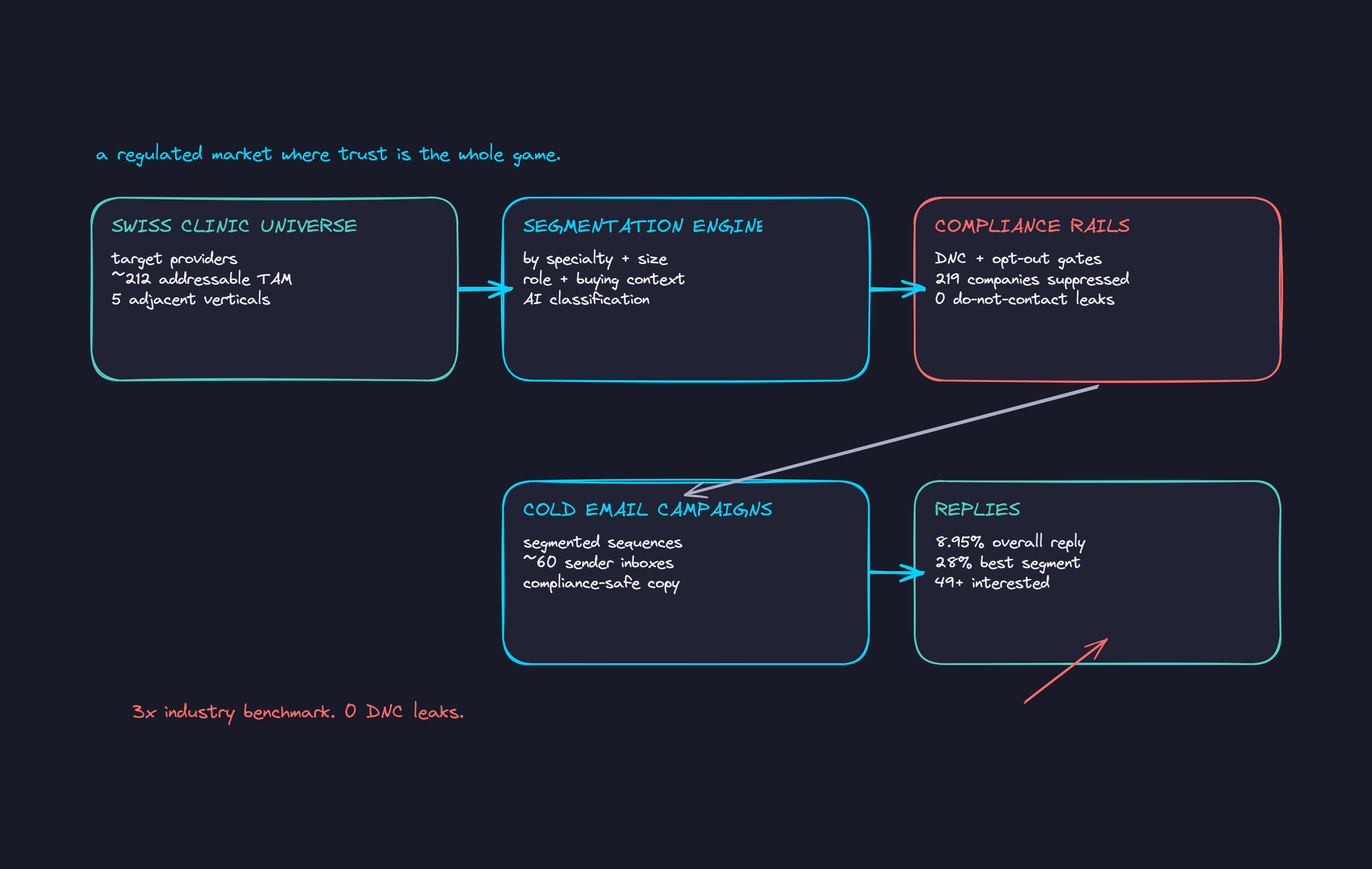
I built a three-layer system: precision discovery, bulletproof DNC compliance, and culturally adapted copy. Data flows left to right, from a hard-ceiling target universe through segmentation and compliance rails, out to segmented campaigns, and back as replies.
Company discovery in a market with a hard ceiling
I used lookalike discovery to find healthcare organizations similar to the client's best existing customers. Three batches produced ~273 net new companies, of which 212 passed ICP qualification. I filtered on geography (German-speaking cantons), sector (hospitals, clinics, rehab centers, nursing homes, health insurers), size (20+ employees), and existing chatbot detection, with encoding-safe regex to handle Swiss location data quirks that defeated standard keyword matching.
Adjacent vertical expansion
Once the core universe was worked, I expanded into 5 adjacent verticals: nursing homes, psychiatric clinics, home care organizations, and health insurers, adding 320+ new companies while keeping the same qualification bar.
DNC compliance system, built from a crisis
Campaign 1 left compliance debt: contacts from organizations that said "Not Interested" reappeared in Campaign 2, and the project nearly got cancelled. I built a four-layer DNC system: a DNC_Companies table (219 organizations), a DNC_Contacts table (1,462 contacts), automated SmartLead removal, and a boolean Push_Ready gate. The result was zero DNC leaks across Campaigns 2 and 3.
Cultural adaptation: Du/Sie split and Swiss German copy
I built separate Du and Sie variants with a Sie-option PS in every sequence, replaced "Hoi" with "Hallo" because the casual greeting read as too informal for hospital directors, and used gender-aware German salutations from enrichment data. Round-robin distribution across 3-day windows meant no two people at the same hospital got emails on the same day, across ~60 sender variants for deliverability protection.
Results
Campaign health
| Metric | Result |
|---|---|
| Aggregate reply rate (Campaign 1) | 8.95% (340 / 3,796) |
| Best sub-campaign reply rate | 28% |
| Interested prospects (all campaigns) | 49+ |
| DNC companies tracked | 219 |
| DNC contacts tracked | 1,462 |
| DNC leaks after system build | 0 |
| Sender variants in rotation | ~60 |
| Total addressable market (net new cos) | ~212 |
| Adjacent verticals discovered | 5 |
Want numbers like these for your pipeline?
Book a 15-min callFit
Who this is for
- SaaS companies selling into regulated European healthcare where GDPR compliance, data sovereignty, and cultural fluency are not optional, they are the price of admission to even start a conversation.
- Businesses targeting small, high-value addressable markets (under 500 total companies) where every lead is precious, DNC compliance must be organizational-level, and volume plays are impossible.
- Companies expanding outreach in multilingual markets (Switzerland, Belgium, Canada) where a single pronoun choice or greeting can determine whether your email gets a reply or a complaint.
Stack
Tools used






Ready to reach healthcare decision-makers in regulated markets?
See how a compliant, culturally-adapted outbound system gets built for your market, without a single do-not-contact mistake.
Book Your Free Strategy Call